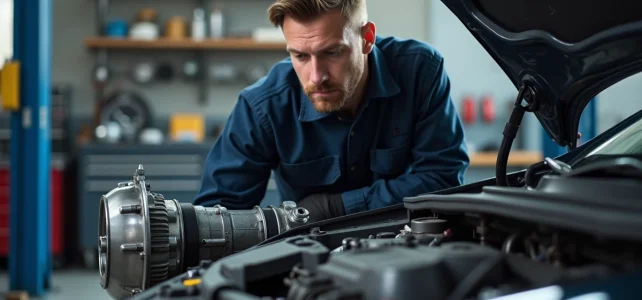
The semi-automatic gearbox is based on a classic manual gearbox architecture where the clutch and gear shifting are controlled by an electronic calculator and electro-hydraulic actuators. The driver retains control over gear selection via a sequential lever or paddle shifters on the steering wheel, but no longer operates a clutch pedal. This principle clearly distinguishes it from an automatic gearbox with a torque converter or dual-clutch system, where gear selection is entirely delegated to electronics.
Actuators and calculator: the mechanics behind gear shifting
The heart of the system is the electro-hydraulic clutch actuator. It receives the command to change gears, disengages, engages the corresponding gear, and re-engages in a few hundred milliseconds. In the first generations (Citroën SensoDrive, Renault Quickshift, Alfa Romeo Selespeed), this sequencing suffered from a noticeable interruption time, with a characteristic jerk during re-engagement.
Recommended read : Everything You Need to Know About Real Estate: Tips, Tricks, and Market Trends
More recent versions have shortened this delay thanks to more precise position sensors and engine maps that adapt the RPM during the transition. The calculator also manages the biting point when starting on a slope, replacing the driver’s left foot reflex with an algorithm that modulates the pressure on the clutch disc.
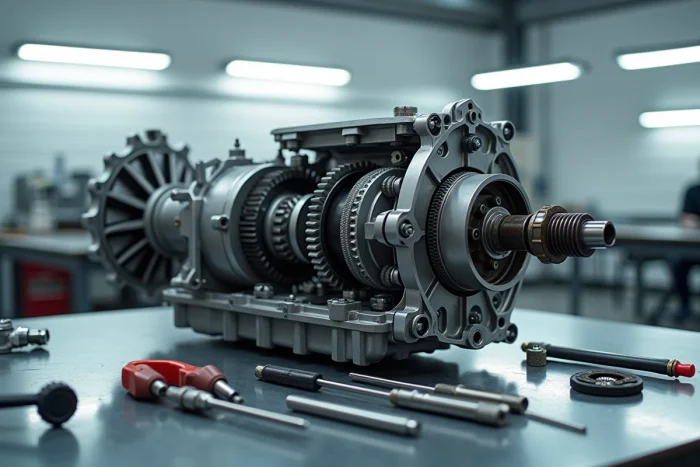
To fully understand what a semi-automatic gearbox is in terms of its architecture, it should be noted that it shares its gears and dry clutch with a manual gearbox, whereas a dual-clutch gearbox (DSG, EDC, DCT) physically duplicates the powertrain to pre-engage the next gear.
Recommended read : Everything You Need to Know About Scops: Benefits, Operations, and Entrepreneur Testimonials
Single or dual-clutch robotic gearbox: a common confusion
We regularly observe confusion between semi-automatic gearbox (single-clutch robotic) and dual-clutch gearbox. Both eliminate the clutch pedal, but their road behavior differs radically.
- The single-clutch robotic gearbox cuts the transmission during each gear change. The driver feels a loss of power, sometimes accompanied by a slight lurch, especially at low RPM in the city.
- The dual-clutch gearbox maintains traction at all times thanks to the alternation between its two half-gearboxes. The shift is almost imperceptible, which explains its current dominance in the market.
- In terms of maintenance costs, the single robotic gearbox remains close to a manual (one disc, one mechanism), while the dual-clutch involves an oil bath or a duplicated dry clutch, which is more expensive to replace.
This technical distinction explains why the single-clutch semi-automatic gearbox is currently in sharp commercial decline. Manufacturers reserve it for entry-level segments or for models nearing the end of their lifecycle.
Reliability and cost of use after eight to ten years
Feedback from garage networks indicates a rise in costly interventions on the actuators and calculators of robotic gearboxes starting from eight to ten years of age. Typical failures concern the clutch actuator (wear of the stepper motor or leakage from the hydraulic block) and the calculator itself, whose replacement represents a significant budget item.
In the used car market, this fragility penalizes resale. An informed buyer will systematically negotiate down the price of a vehicle equipped with an older generation robotic gearbox, anticipating a mid-term actuator replacement. We recommend checking the maintenance history of the actuator and testing the behavior when starting on a slope before any purchase.
Preventive maintenance remains accessible: changing the gearbox oil at the recommended intervals, checking the wear of the clutch disc (identical to a manual), and updating the calculator software when the manufacturer offers it.
Semi-automatic gearbox and driving aids: a changing role
The rise of advanced driver assistance systems (ACC with stop and go, automated traffic management, park assist) transforms the transmission into a software link in partially automated driving. The gearbox no longer receives its commands solely from the driver: assistance calculators directly control gear shifting to maintain a safe distance, manage stop-start, or execute a parallel parking maneuver.
This integration structurally favors transmissions without torque interruption. An ACC system that needs to finely modulate speed does not tolerate the jerk of a single-clutch robotic gearbox. This is one of the reasons why dual-clutch and torque converter systems dominate vehicles equipped with level 2 ADAS.
Thus, the single-clutch semi-automatic gearbox finds itself marginalized by this evolution. It remains relevant on vehicles without advanced aids, or on sports models where the driver specifically seeks sequential gear control without external assistance.
Licensing and regulations: what the semi-automatic gearbox changes
A vehicle equipped with a semi-automatic gearbox does not have a clutch pedal. Taking the driving test in such a vehicle leads to obtaining a automatic gearbox license, with the possibility to later convert to a standard B license.
For drivers already holding a B license, no restrictions apply. The semi-automatic gearbox is driven like any transmission without a clutch pedal.
Insurers and road safety organizations also note a correlation between automatic or semi-automatic transmissions and a decrease in accident rates among certain profiles, particularly young drivers and intensive urban drivers. The reduced mental load associated with gear shifting frees up attention for environmental monitoring.
The single-clutch semi-automatic gearbox has played a transitional technological role between manual and modern transmissions without torque interruption. Its simple architecture and low manufacturing cost have allowed it to democratize driving without a clutch pedal.
With the rise of ADAS and semi-autonomous driving, its space is shrinking each year in favor of dual-clutch and single-speed electric transmissions, which no longer require a gearbox in the traditional sense.