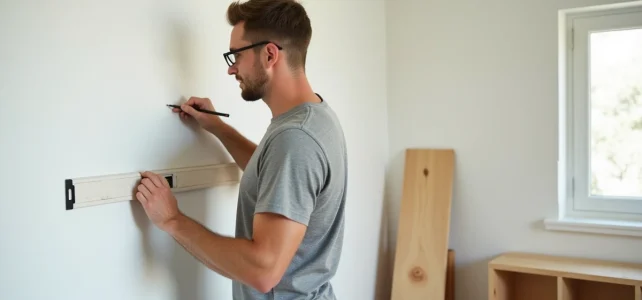
A flat-pack furniture piece placed against a wall rarely touches the surface. The baseboard, even if thin, creates a gap that prevents the furniture from being flush and makes it unstable. You end up with a wardrobe or bookshelf that tips over as soon as you open a drawer at the top. Firmly securing a piece of furniture to the wall with a baseboard requires addressing this gap before drilling anything.
Assess the gap created by the baseboard before any wall fixing
Before taking out the drill, measure the exact thickness of the baseboard. The gap often ranges from a few millimeters to over a centimeter depending on the profile. This gap completely alters the mechanics of fixing: a bracket screwed into empty space holds nothing.
See also : Ideas and practical tips for stylishly decorating and furnishing your home
Two situations arise. If the furniture is as wide as the wall section, you might consider cutting the baseboard at the level of the furniture. If the furniture is narrower, it’s better to compensate for the gap without touching the baseboard. The choice also depends on the wall covering: on drywall, the requirements for anchors are not the same as on concrete blocks or solid bricks.
It is advisable to check the nature of the wall with a stud finder or a simple magnet (to locate the metal tracks behind the drywall). It’s at this stage that you decide on the type of anchor suitable, not at the time of drilling. Knowing how to fix a piece of furniture to the wall with a baseboard first requires understanding what is behind the baseboard and behind the wall.
Further reading : Practical tips for organizing an unforgettable trip around the world
Shims and baseboard cutting: two compensating techniques
Cutting the baseboard to the template of the furniture
This method yields the cleanest finish. You trace the outline of the furniture on the baseboard, then cut with a multi-tool oscillating saw. The furniture then fits directly against the wall, eliminating any overhang.
Opinions vary on this point: some hesitate to cut a baseboard in good condition, especially in rental properties. If the baseboard is clipped, it can sometimes be removed from the affected section without cutting, and then replaced after a possible move.
Compensating with shims or battens
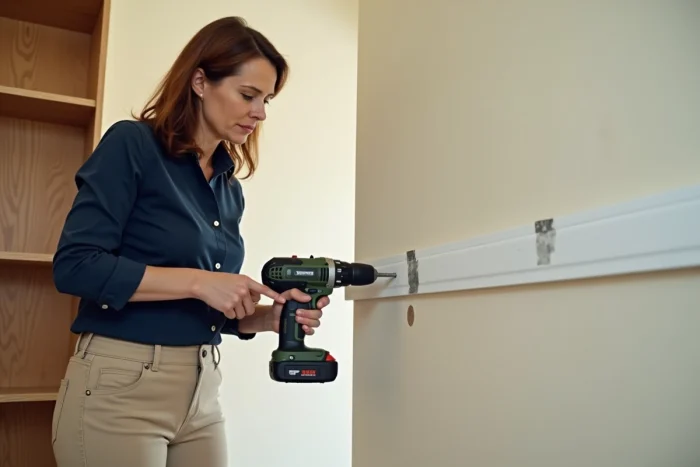
When you don’t want to touch the baseboard, you attach a horizontal batten to the wall at the desired height, with a thickness that matches the measured gap. The furniture is then screwed into this batten. The batten creates a stable support surface and distributes the forces along a line rather than on two isolated screw points.
- Solid wood batten (spruce, beech) cut to the width of the furniture, secured with anchors suitable for the wall material.
- Plywood shim glued to the back of the furniture to compensate for the gap at the bottom, combined with a high fixing using a bracket.
- MDF spacer painted to match the wall color, screwed behind the furniture for a discreet finish.
In both cases, the high fixing remains mandatory: it is what prevents tipping. The lower shim only stabilizes the base.
Anchors and fixings suitable for the type of wall
The choice of anchor determines the overall strength. On a drywall (BA13) wall, standard expansion anchors are not sufficient to hold heavy furniture. Metal Molly anchors are preferred, as they expand behind the board and provide much better resistance to pulling out.
On a hollow brick wall, the hammer-in anchor should be avoided. A locking shape anchor (like an anchor for hollow materials) grips in the cells and better withstands repeated vibrations (opening doors, drawers).
On concrete or solid block, a standard nylon anchor with a screw of appropriate diameter does the job. You drill with a hammer drill, insert the anchor, and screw it in. The key point here is to drill to the correct depth: the screw must anchor along the entire useful length of the anchor, not just the first few millimeters.
Anti-tipping fixation: a matter of safety, not decoration
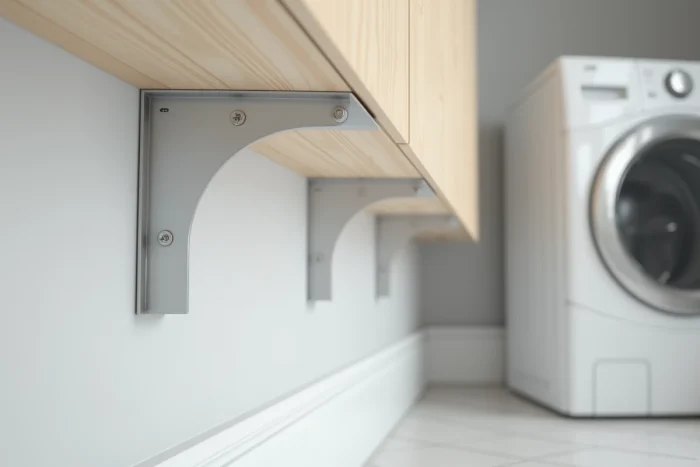
Since the recall campaign related to IKEA MALM dressers, several regulatory authorities (the CPSC in the United States, the European Commission via the Safety Gate) emphasize one point: any furniture that could tip over must be anchored to the wall, particularly in homes with children. The anchoring must withstand climbing efforts, not just a simple lean.
IKEA has indicated since 2023 in its manuals that the wall fixing kit is part of the furniture’s safety system. Failing to install it could make the buyer liable in case of an accident. Some home insurers are starting to consider the absence of fixing as negligence when the manufacturer explicitly provided for it.
The anti-tipping straps sold in kits (often provided with the furniture) are secured with one screw into the wall and one screw into the top of the furniture. They tolerate the gap of the baseboard since they are flexible. This is a quick solution to secure a piece of furniture already in place without disassembling everything.
Order of operations for a solid fixing with baseboard
- Measure the thickness of the baseboard and identify the nature of the wall (drywall, brick, concrete).
- Choose the compensating method: cutting the baseboard, wall batten, or rear shims.
- Select the appropriate anchors for the material and drill at the marked locations.
- Fix the batten or bracket to the wall, then screw the furniture onto it while checking for plumb.
- Add an anti-tipping strap or link at the top if the furniture exceeds one meter in height.
Finish with a simple test: push firmly down on the top of the furniture while pulling towards you. If the furniture doesn’t move, the fixing is correct. If you feel any play, tighten it again or add an additional fixing point.
The baseboard remains a detail of finishing, but it changes the entire anchoring mechanics of a piece of furniture. Addressing this gap upfront prevents ending up with screws working in empty space and a piece of furniture that eventually detaches from the wall over the months.