Your neighbor shares an alert in a local Facebook group. A local Instagram account announces that a school is closing. Before anyone checks the facts, the information is already spreading. Keeping up with local news is no longer just a matter of reading the morning paper: there are more channels than ever, and with them comes a greater risk of sharing inaccurate information. Knowing where to look—and, above all, how to cross-check—makes all the difference when it comes to staying informed about what’s happening close to home.
How to verify local news before sharing it: a three-step approach
Have you noticed how a post in a neighborhood group can be shared dozens of times in just a few hours? The problem is that no one checks the source before clicking “share.”
There’s a simple way to avoid spreading misinformation. First, check whether a local newsroom has published the same information. A regional newspaper, local online radio station, or municipal news website has journalists who verify the facts before publishing.
If no news outlet has reported it, check your town hall or intermunicipal authority’s official website. Municipal orders, facility closures, and transport disruptions are posted there directly. Local outlets such as L’Intercom also cover news in their area, with editorial fact-checking.
Finally, if the original source is a personal social media account, see whether the post cites a document, an official link, or the name of an official. Information with no identifiable source isn’t worth sharing.
Local news channels: newspapers, apps, and municipal alerts
There are three main ways to keep up with what’s happening in your town. Each serves a different need.
Print and digital local news
Regional newspapers remain the most structured way to follow local news. What many people don’t know is that the Ministry of Culture also supports digital local media, including news websites, newsletters, online TV channels, and online radio stations. These newsrooms cover areas that major outlets sometimes overlook.
Cross-checking multiple local newsrooms makes what you read more reliable. No single outlet can cover everything, and the lack of local media pluralism is an issue highlighted by press observers in France.
Municipal apps and social media
Several apps allow local authorities to send alerts directly to your phone. PanneauPocket, for example, is used by many municipalities to share practical information about weather, school disruptions, and facility closures.
Town halls are also making use of social media. Some cities share news through WhatsApp channels, alongside their website and Facebook or Instagram page. The advantage is that you receive updates without having to look for them.
- Your town hall’s Facebook and Instagram pages share local events and municipal council decisions.
- Municipal WhatsApp or Telegram channels send targeted alerts about roadworks, outages, and severe weather.
- Apps such as PanneauPocket bring together announcements from your town and neighboring municipalities in a single calendar.
FR-Alert: a different kind of alert system
FR-Alert is not an app. It is an alert system run by the Ministry of the Interior that warns people of imminent danger in a specific geographic area. No installation is required: if you’re in the affected area, the notification arrives directly on your phone.
This system does not replace your day-to-day local news sources. It is used only in the event of a serious threat, such as a flood, industrial accident, or terrorist attack. Mistaking FR-Alert for a regular news source would be a mistake.
Stay on top of local news without getting overwhelmed
There’s no point in following more sources if you can no longer tell what’s useful from what’s not. The goal isn’t to follow everything, but to choose two or three complementary channels.
One effective combination: a subscription to a local newsletter for in-depth coverage, a municipal Facebook page for practical alerts, and a weekly check of your intermunicipal authority’s website for council decisions and ongoing projects.
Why this combination? The newsletter gives you context, such as an in-depth article about an urban development project or a profile of a local association. The municipal page keeps you up to date in real time about a closed road or a change to waste collection. The intermunicipal website covers decisions that affect more than just your town.
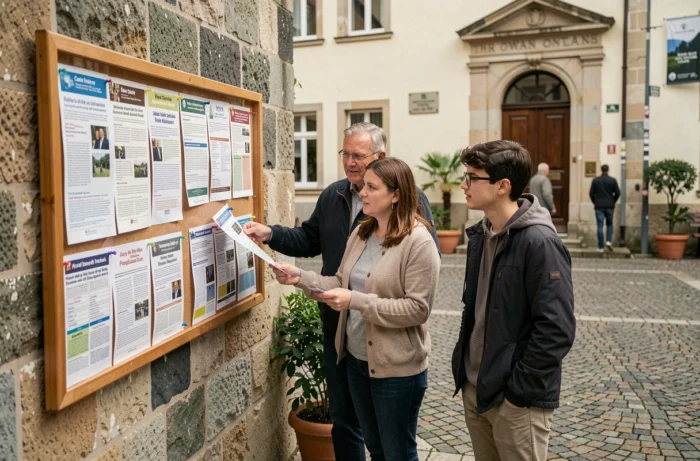
Local news and public funding: a fragile ecosystem worth knowing about
France’s local news landscape is about more than major regional newspapers. The Ministry of Culture funds a program for social and local news media. This funding also covers digital formats, including websites, online radio stations, online TV channels, and newsletters.
This public funding exists because local news coverage remains uneven across different areas. Some communities have only one newspaper, making it harder for residents to cross-check information.
In practice, this means your town may be covered by a local outlet you haven’t discovered yet. Searching for “local news + your town’s name” in a search engine may turn up a website, online radio station, or newsletter that covers everyday life in your area from a journalistic perspective.
- Check the Ministry of Culture’s list of press subsidies to find out which outlets in your region receive support.
- Try local online radio and TV stations: they often cover events that don’t make it into print.
- Subscribe to at least one local newsletter to get regular updates without having to search for them.
Reliable local news doesn’t just appear out of nowhere. It takes a little filtering, a habit of checking the facts, and knowing which channels actually cover your area. Two or three well-chosen sources are enough to keep you up to date on what matters close to home, without wasting time sorting rumors from facts.