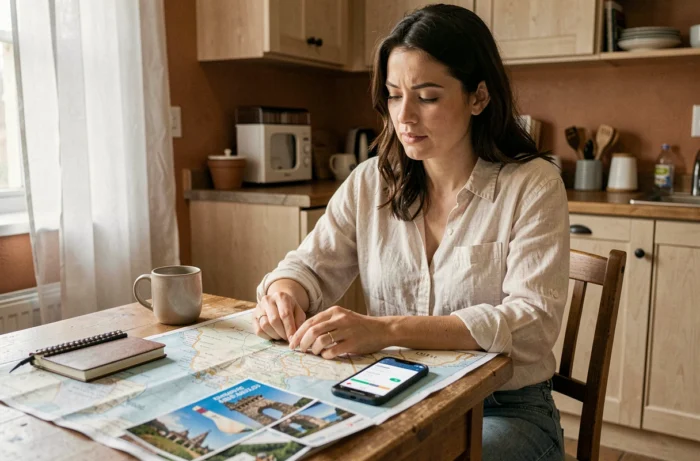
Planning a trip without exceeding your budget starts well before you book your ticket. The usual reflex is to compare the prices shown, but the true cost of a trip also includes what happens when plans change: cancellations, partial refunds and hidden fees. Building a realistic budget means factoring in these gray areas from the start.
Travel budget and real cost: beyond the advertised price
Have you ever noticed that a rock-bottom flight can sometimes end up costing more than a standard ticket? Baggage fees, seat selection, mandatory insurance: the advertised fare is only a fraction of the total cost. The same applies to accommodation and activities.
An apparently cheap journey can come with extra fees or make it harder to get a refund if you book through a third-party platform. Before confirming a booking, take the time to compare the total price, not just the base fare.
In practice, this means adding up every item: taxes, service fees and options added automatically. A travel comparison site such as voyagesnet.com displays these totals, making it easier to compare different offers.
Refund policies are part of your budget
A cheaper booking can end up costing the most if you have to cancel. Checking the refund policy before you pay is a budgeting step, not an administrative detail.
Ask yourself three questions before each booking:
- Is the fare refundable, and if so, under what conditions (deadline, amount withheld, voucher or bank transfer)?
- Does the third-party platform charge its own cancellation fees on top of the provider’s fees?
- Is cancellation insurance included, or do you need to buy it separately (and at what price)?
A European Commission document states that Member States must transpose revised rules on package travel by 29 September 2028, with the rules taking effect from 29 March 2029. For a trip being planned today, it’s best to check which protections are actually in force rather than rely on announced changes.

Build a realistic vacation budget, item by item
Most guides recommend listing transportation, accommodation and meals. That’s a good start, but it leaves out expenses that crop up while you’re there: an activity you spot at the last minute, an unexpected taxi ride or a souvenir. The trap is budgeting only for planned expenses.
A contingency fund: the expense no one budgets for
Set aside a dedicated amount for unexpected expenses. Allowing ten to fifteen percent of your total budget for extras means you won’t have to cut back on meals or sightseeing at the end of your trip. It’s not a waste of money: it’s what makes a trip more enjoyable when an opportunity comes along.
For the rest, think in terms of a daily budget. Divide your total allowance (excluding round-trip transportation) by the number of days. This daily figure becomes your guide: each evening, you’ll know whether you’re on track.
Multimodal transportation: savings and limitations
Combining trains, buses and carpooling on the same route can reduce travel costs. The European Commission notes that travelers can have difficulty finding and booking a combination of journeys with multiple operators. European initiatives aim to make comparisons easier, but the process can still be time-consuming.
The trick is to book each leg separately and keep a copy of every confirmation. If one leg is delayed, you can prove that you missed your connection and request compensation from the right carrier.
On-the-ground expenses: meals, activities and practical tips
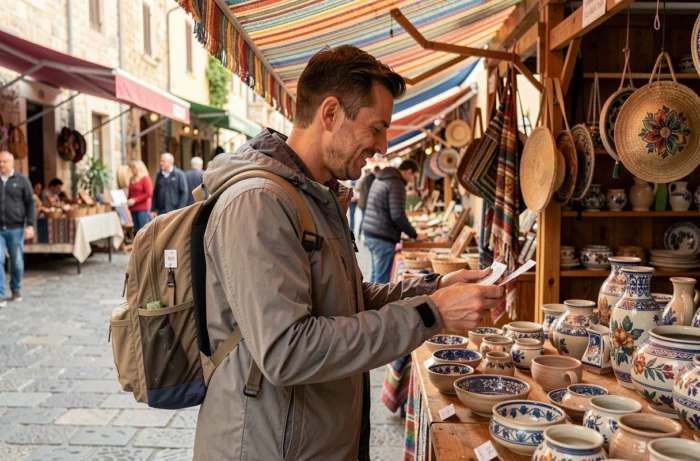
Food is where the gap between your planned budget and actual spending can grow fastest. Eating at restaurants twice a day for a week can add up to far more than a mix of local cooking and market meals.
Why choose this approach? Because local markets offer two benefits at once: lower costs and a cultural experience. Buying fruit, cheese or bread at a covered market is as much a part of the trip as visiting a museum.
Free activities and bundled tickets
In most cities, municipal museums offer free admission slots on certain days of the week or in the evening. Hiking trails, historic neighborhoods and parks are free.
- Check the local tourist office’s official website before you leave: day passes often bundle transportation and discounted admission
- Free walking tours operate on a tip basis and cover city centers in most European capitals
- Geocaching or audio tour apps can turn a walk into an activity at no extra cost
Save before you leave: a step-by-step approach
Saving for a trip works best when you have a specific goal. Set a total amount and a departure date, then calculate how much to put aside each month. This gradual approach is more sustainable than making a drastic effort in the final few weeks.
Setting up an automatic monthly transfer to a dedicated account removes the temptation to put it off. Even a modest amount, saved over several months, can add up to enough for a trip in Europe.
Cutting unused subscriptions (streaming services, gym memberships, monthly boxes) can often free up enough to pay for several nights of accommodation. It’s worth doing this exercise once: list your automatic payments and cancel the ones you no longer use.
A well-budgeted trip isn’t just about finding the lowest price. It’s about balancing the fare, cancellation terms and a contingency fund. Travelers who factor in all three from the planning stage rarely spend more than expected—and can enjoy their trip without counting every penny.