
Improving daily well-being relies on measurable levers, not vague intentions. Some habits generate documented effects on physical and mental health, while others remain anecdotal. The ten tips that follow are based on recent data to distinguish what works from what is merely a feeling.
1. Reduce sitting time with active breaks every 30 minutes

The WHO has emphasized since 2023 a point that most wellness articles overlook: reducing sitting time is as important as exercising. The official message recommends active breaks of two to three minutes every thirty to sixty minutes.
Specifically, getting up to walk down a hallway or go up a flight of stairs is enough to break sedentary behavior. This approach does not replace structured physical activity but complements the benefits for stress and anxiety. To delve deeper into well-being on Belle et Épanouie, these micro-actions provide an accessible first step for all profiles.
2. Establish a sleep routine with fixed hours

The High Authority of Health published guidelines for adult sleep in 2023. Among the key points: the regularity of bedtime and wake-up time weighs more than the total duration.
Going to bed at the same time every night, including on weekends, synchronizes the circadian rhythm. The HAS also recommends a screen break before bedtime, as blue light delays melatonin secretion. Few mainstream sources cite this official framework, even though it provides verifiable guidelines.
3. Aim for WHO recommendations for moderate physical activity

The WHO sets a goal of 150 to 300 minutes of moderate physical activity per week. This volume corresponds to about thirty minutes of brisk walking five days a week.
The benefits apply equally to mental health (reduction of stress and anxiety) as well as physical health. However, significantly exceeding this threshold does not yield proportional gains in perceived well-being. The dosage matters more than the maximum intensity.
4. Practice micro-meditation at the workplace
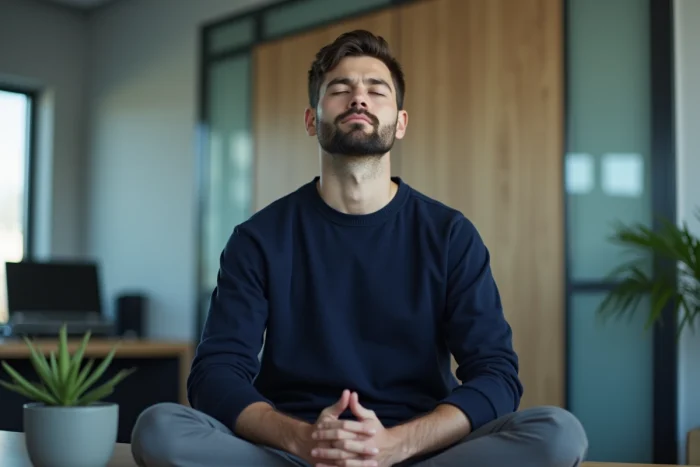
Studies published in the Journal of Occupational Health Psychology in 2022 and in Mindfulness in 2023 show that sessions of five to ten minutes of meditation measurably reduce work-related stress. The effects extend to concentration and emotional regulation.
Unlike a longer practice that requires a dedicated setting, micro-meditation can fit between two meetings or during a break. The key is not the duration but the regularity: a few minutes each day yield more results than a prolonged weekly session.
5. Structure your diet around complete meals

Diet directly influences quality of life and stress resistance. Structuring three complete meals a day, with vegetables, proteins, and complex carbohydrates, stabilizes energy and limits mood swings.
A common pitfall: replacing a meal with snacking or skipping breakfast thinking it saves time. In terms of daily well-being, dietary regularity aligns with sleep regularity as a factor of physical and mental stability.
6. Keep a gratitude journal three times a week

Gratitude is among the most studied practices in positive psychology. Research protocols typically use a frequency of three entries per week, not daily. Each entry consists of writing three positive things from the day.
The gain lies in the overall perception of satisfaction, not in solving concrete problems. This cognitive reframing works best when it remains spontaneous and unforced. Forcing the exercise every evening ultimately drains it of its meaning.
7. Explore exercise prescriptions with your primary care physician

The “exercise prescription” program, evaluated by the Ministry of Sports in 2022-2023, allows individuals with a long-term condition to benefit from tailored physical activity prescribed by their doctor.
Field feedback shows observed benefits on patient adherence and quality of life. The primary care physician plays a triggering role: the prescription legitimizes physical activity as a legitimate form of care. This lever remains underutilized, even by healthcare professionals.
8. Limit screens at least one hour before bedtime

This advice often comes up, but the HAS formalizes it in its 2023 sleep guidelines. The recommended cutoff time before bedtime has a direct impact on sleep onset latency and the quality of deep sleep.
Replacing screens with a calm activity (reading, breathing, stretching) prepares the body for rest. A frequently overlooked point: the brightness of the environment also matters. Dimming the overall lighting of the home thirty minutes before bedtime complements the digital break.
9. Integrate controlled breathing exercises into your routine

Controlled breathing (slow inhalation, prolonged exhalation) activates the parasympathetic nervous system. A few cycles are enough to lower heart rate and cortisol levels.
- Heart coherence breathing: five seconds of inhalation, five seconds of exhalation, for five minutes
- 4-7-8 breathing: inhale for four counts, hold for seven, exhale for eight
- Simple abdominal breathing: inflate the belly on inhalation, pull it in on exhalation
These techniques work in any context, including during transport or at the office.
10. Dedicate time to a chosen physical or creative activity for pleasure

The final lever concerns the relationship with free time. A freely chosen activity generates more well-being than an imposed activity, even if the latter is objectively beneficial. The notion of intrinsic pleasure conditions long-term adherence.
Whether it’s running, pottery, or cooking, the determining factor remains the desire to return to it. Forcing a practice because it is “good for health” without finding satisfaction leads to the opposite effect: quick abandonment and associated guilt.
Among these ten tips, the most documented levers remain reducing sitting time, maintaining sleep regularity, and moderate physical activity calibrated to WHO guidelines. The rest involves personal adjustments whose effectiveness varies by profile, but whose entry cost is close to zero.